The People

The ROM, the largest museum in North America, has more than one million visitors every year. The founder Sir Byron Edmund walker built a team of people to make the Rom a world-class museum. He also built foundation and gave direction to many large institutions such as the University of Toronto and the Canadian Bank of Commerce ( He was the president of CIBC in 1907). He was super influential that his success cannot be separated with his connections with other influential people in the society. When he was working in New York, galleries and museums in NYC inspired him a lot that he wanted to pursue his cultural interests by founding a major museum in the city of Toronto. Yet, after many years of planning and negotiating, the Royal Museum officially opened to the public on March 19, 1914. He retired from the position until the end of his life journey.

Alone we can so little; together we can do so much. Walker had an idea of what he wanted for the museum but he only knew something of the humanities and their practitioners. So now, Walker needed a favourable archaeologists to collaborate with him to make his dream real. His son’s friend Charles Trick Currelly was his best choice.
The Architecture


The Italianate and Neo-Romanesque building was made of rounded arches and segmented windows. The original structure was in good shape except it doesn’t fit in the contemporary minimal art taste. The Crystal is the current version of the ROM that is a renovation which costs a multimillion-dollar.
Social Factors
“The story of how the ROM became a world-class cultural institution stretches from Toronto to China and covers major cultural shifts that shunted Canadian Methodism from piety to social engineering, the rise of the Toronto plutocracy, and the importance of a randomly placed postcard, among other things.”
Walker’s Efforts on The Museum
The Rom focuses on combining nature and culture due to Walker’s own wide-ranging interest. He started ” his collecting journey with fossils, which he donated to the ROM with his paleontological library to the Rom.” Then, he started ” the funding of dinosaur digs in the badlands of Alberta. One of the new species found there was named after him—Parasaurolophus walkeri. He was equally fascinated with world cultures and his impressive collection of Japanese ukiyo-e was donated to the Museum upon his death. Walker also established a tradition of continued philanthropy at the ROM, forming a fundraising group in 1917 called The Twenty Friends of the Arts. ”

The Development of Galleries
Originally, there were only five different galleries in the museum. They were archaeology, geology, mineralogy, palaeontology and zoology . The interior of the museum was very traditional that the specimens of insects and animals were glued on on the wall with glass pieces.
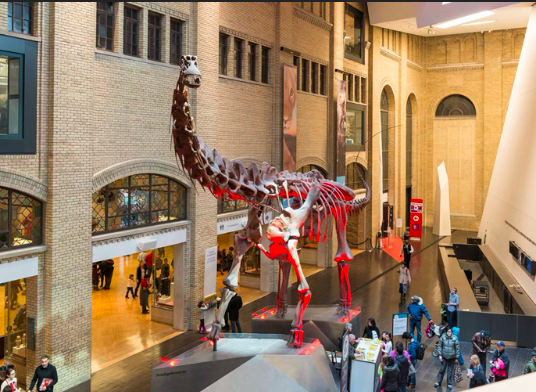
In 1960, the museum began to open more in-depth exhibitions, among which the most famous object was a giant dinosaur fossil. The trend of exhibiting giant ancient fossils continues to this day.
In 1980, the museum built an artificial bat cave and received widespread attention after. Indeed, this bat cave was extremely advanced that it utilized sound, light and gentle air flow to simulate a real bat cave so as to provide the best experience to the spectator.
After many times of evolution, the ROM now is mainly divided into two parts: the Natural History Galleries and the World Culture Galleries.
In Conclusion
Most people choose to engage in business and engineering related fields now, because their thoughts lead them to believe that is the way to make their fortune. With the growth of the society, more people participate in this concept, and fewer people are paying tuition to learn knowledge related to Literature and history. However, history teaches us not only what happened in the past, but also the wisdom of people in the past, such as getting inspiration by visiting cities, finding partners to cooperate, and using technology to achieve goals. We should all appreciate the existence of the museum since it records many significant societal tendency.
Citations
 Sabrina's Blog